> **Key Takeaways**
> * Full context windows trap production email agents; structured metadata filtering beats brute-force token stuffing for accuracy and cost.
> * Treating your email inbox as the primary state store eliminates sync drift between vector databases and actual communication history.
> * Memory architecture must optimize for storage over compute; shift summarization workloads to async processes to slash bills.
> * Persistent memory requires explicit expiration and PII handling policies at the schema level, never as an afterthought in the prompt.
Table of Contents
* [Common Mistakes to Avoid](#common-mistakes-to-avoid)
* [The Context Window Trap: Why More Tokens ≠ Better Memory](#the-context-window-trap-why-more-tokens--better-memory)
* [Structured State vs. Unstructured History: Choosing the Right Primitive](#structured-state-vs-unstructured-history-choosing-the-right-primitive)
* [The Inbox as Source of Truth: Eliminating Sync Drift](#the-inbox-as-source-of-truth-eliminating-sync-drift)
* [Cost-Aware Memory Design: Storage Over Compute](#cost-aware-memory-design-storage-over-compute)
* [Memory Hygiene: Expiration, Redaction, and Pruning](#memory-hygiene-expiration-redaction-and-pruning)
* [Multi-Agent Memory Isolation and Sharing](#multi-agent-memory-isolation-and-sharing)
* [Benchmarking Memory Performance: Beyond Accuracy](#benchmarking-memory-performance-beyond-accuracy)
* [Implementing Memory on Credit-Based Infrastructure](#implementing-memory-on-credit-based-infrastructure)
* [Frequently Asked Questions](#frequently-asked-questions)
* [Further Reading](#further-reading)
Common Mistakes to Avoid
Let me be direct. Most agent failures stem from lazy architecture. You cannot prompt-engineer your way out of bad infrastructure decisions.
**Blindly appending entire email threads to context.** This inflates token usage massively. It introduces conflicting information that confuses the model’s recency bias. The agent sees three different shipping dates and picks the wrong one because it appeared first in a massive text block.
**Using vector search for deterministic lookups.** Searching embeddings for order IDs or timestamps is probabilistic. It is unreliable. Use structured key-value stores for factual retrieval. Vectors capture vibes, not facts.
**Ignoring memory egress costs.** Developers obsess over inference pricing but ignore read/write costs. Reading memory on every turn compounds faster than generation costs in high-volume pipelines. A cheap model with expensive memory access still bankrupts you.
The Context Window Trap: Why More Tokens ≠ Better Memory
Marketing teams love boasting about 2M+ token context windows. Engineers know better. In 2026, raw window size is a vanity metric for production email agents.
Non-linear latency penalties in large models
Inference latency scales non-linearly with input size. Benchmarks from early 2026 LLM performance reports confirm this reality. Agents utilizing full-context retrieval experience a 300-400% increase in Time-to-First-Token (TTFT).
This happens even when the smaller context fits within the window. Attention mechanisms still process all tokens. Selective retrieval runs 3-4x faster for equivalent accuracy. Your users care about response time, not theoretical capacity.
Recency bias vs. Buried context
Models suffer from "lost in the middle" phenomena. Critical details buried in the center of a long context get ignored. The model over-indexes on the system prompt and the most recent user message.
Stuffing six months of email history into a prompt guarantees failure. The agent confidently recalls outdated return policies while ignoring yesterday's policy update. Structured metadata filtering solves this. You feed only relevant fragments. Accuracy improves because noise decreases.
The true cost of "just add it all"
Token pricing adds up fast. Processing 500k tokens per interaction costs real money. Multiply that by thousands of daily agent interactions. Your unit economics collapse.
Selective retrieval reduces token burn by orders of magnitude. You pay for relevance, not volume. Check out [The Agent Memory Stack: A Step-by-Step Guide to Building Agents That Never Forget](https://www.srun66.com/) for implementation details. Brute force is waste, not engineering.
Structured State vs. Unstructured History: Choosing the Right Primitive
Most "memory" queries in email agents are actually deterministic lookups. Users ask about order status, last contact date, or thread IDs. These are not semantic questions. Routing them to structured KV stores eliminates hallucination entirely.
When to use JSON schemas over raw text
Raw text chunks fail at precision. Embeddings map meaning, not exact values. Asking a vector DB for "Order #12345" returns similar-looking numbers.
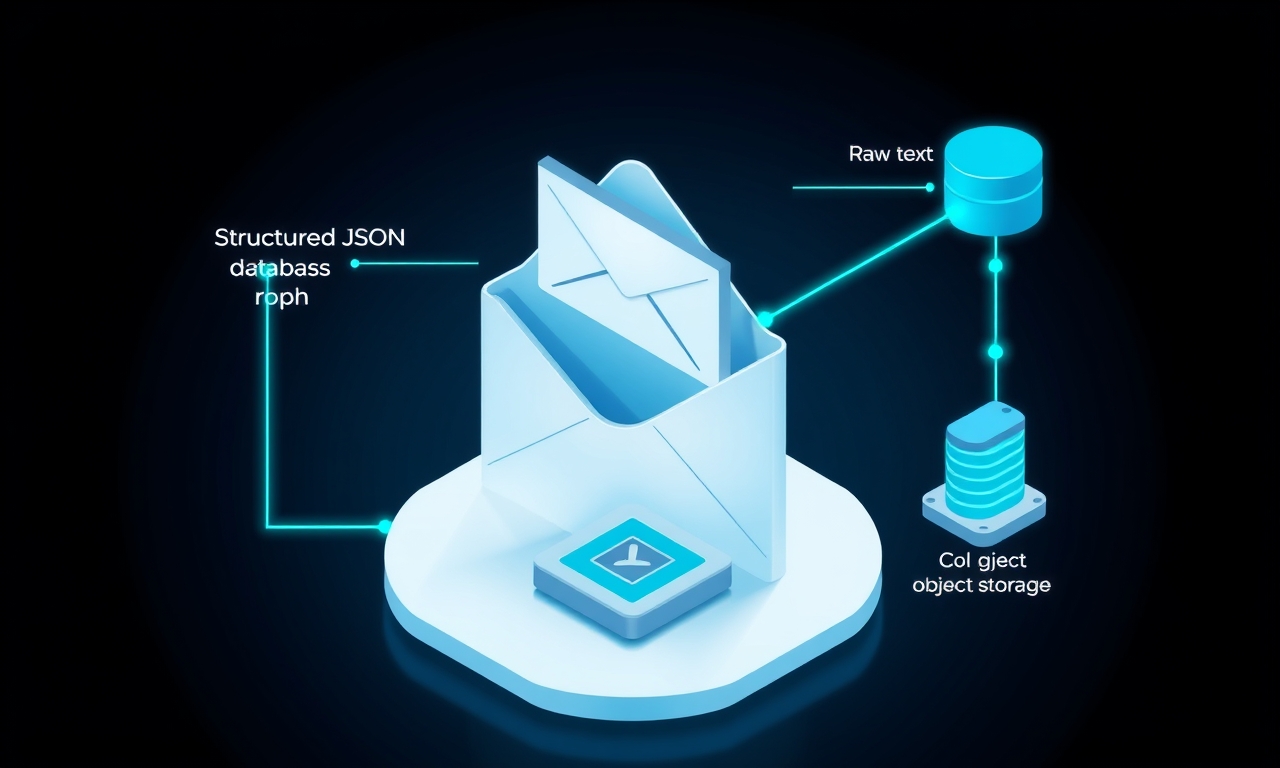
JSON schemas enforce types. Dates remain dates. IDs stay unique. Store conversation summaries and extracted entities as structured objects. Keep raw text only for semantic recall. Hybrid architectures win because they respect data types.
Hybrid retrieval: Metadata filtering + semantic search
Combine both worlds. Filter structured metadata first. Narrow the search space to relevant threads or date ranges. Then apply semantic search within that filtered set.
This two-stage approach cuts latency. It prevents cross-thread contamination. The agent never confuses Customer A's complaint with Customer B's praise. Developer surveys show structured state management reduces error rates significantly in complex threading scenarios.
Schema design for email-native agent memory
Design schemas around email primitives. Include thread IDs, sender domains, and timestamp ranges. Add custom fields for business logic like ticket status or sentiment scores.
Avoid generic "memory" blobs. Specificity enables efficient indexing. Read [Wiring Your First AI Agent Email Pipeline: A Stateless-to-Stateful Migration Path](https://www.srun66.com/) to see practical schema examples. Good structure prevents bad outputs.
The Inbox as Source of Truth: Eliminating Sync Drift
Dual-write architectures fail. Syncing email to a separate vector database creates inevitable divergence. The inbox moves forward while the cache lags behind.
Why dual-write architectures fail
Email is mutable. Messages get deleted, moved, or flagged. External databases rarely capture these state changes perfectly. Race conditions corrupt memory.
Agents query stale data and act on phantom emails. Debugging sync issues consumes engineering cycles. You chase ghosts instead of building features. Single sources of truth prevent this class of bugs entirely.
Querying email headers directly via API
Modern email APIs support efficient querying. Fetch headers for metadata without downloading bodies. Retrieve specific messages by immutable ID.
Treat the API as your database. It already indexes everything. You gain consistency at zero additional sync cost. Architectural patterns in 2026 favor this direct approach. Cached embeddings become optional optimizations, not primary stores.
Reconstructing state from immutable message IDs
Message IDs never change. Build state reconstruction logic around them. Store references, not copies.
When an agent needs context, fetch fresh data. Freshness guarantees accuracy. Learn more in [How to Engineer Persistent Agent Memory Using Email Infrastructure](https://www.srun66.com/). Trust the protocol, not the cache.
Cost-Aware Memory Design: Storage Over Compute
Object storage costs remain negligible in 2026. GPU inference remains expensive. Optimize accordingly. Shift memory architecture from compute-heavy summarization to storage-heavy structured indexing.
Object storage pricing vs. Inference math
R2 and S3-compatible storage costs roughly $0.015/GB/mo. Storing decades of email history costs pennies. A single complex summarization call burns dollars in compute.
Store raw history cheaply. Summarize asynchronously offline. Real-time summarization during user interactions wastes money. Decouple memory writes from user-facing latency. Users get instant responses while background workers process history.
Async summarization: decoupling writes from latency
Do not make users wait for memory updates. Write new messages to storage immediately. Trigger summarization jobs later.
This pattern reduces per-interaction memory costs by over 90%. Compute resources focus on generation, not bookkeeping. Batch processing amortizes overhead. Efficiency compounds at scale.
Tiered memory: hot vs. Cold access patterns
Not all memory deserves equal treatment. Recent threads need fast access. Archive older conversations in cold storage.
Route queries intelligently. Hot paths use structured indexes. Cold paths trigger retrieval jobs. This tiering keeps hot-path latency low. Review [The Hidden Costs of x402 for AI Agent Email Pipelines](https://www.srun66.com/) for deeper cost analysis. Smart tiering beats uniform spending.
Memory Hygiene: Expiration, Redaction, and Pruning
Prompting an agent to "forget old information" is unreliable. Models do not truly forget. Enforcement must happen at the storage layer.
Schema-level TTLs vs. Prompt instructions
Time-to-live settings expire data automatically. Old records vanish before reaching the context window. Prompts cannot guarantee deletion.
Compliance demands certainty. GDPR requires actual removal, not behavioral suggestions. Implement TTLs on sensitive fields. Let infrastructure handle retention policies. Inference layers should never manage data lifecycle.
Automated PII detection before persistence
Scan incoming emails before storage. Redact credit cards, SSNs, and health data. Store sanitized versions permanently.
Once PII enters memory, containment fails. Pre-write filters stop leaks at the gate. Use dedicated detection models. Do not rely on the main agent to self-censor. Safety requires separation of concerns.
Graceful degradation when memory expires
Expired data leaves gaps. Handle missing context explicitly. Tell users when information falls outside retention periods.
Never fabricate answers to fill voids. Honest limitations build trust. Read [Why AI Email Agents Fail: Architecture, State, and Deliverability](https://www.srun66.com/) for failure mode analysis. Transparency beats confident wrongness.
Multi-Agent Memory Isolation and Sharing
Most multi-agent memory corruption comes from implicit shared state. Explicit namespace isolation prevents cascading failures across agent fleets.
Namespace strategies for shared inboxes
Prefix memory keys with agent identifiers. Sales bots access sales namespaces. Support bots access support namespaces.
Shared inboxes require routing logic. Tag incoming messages before storage. Agents read only tagged subsets. Cross-contamination becomes architecturally impossible. Isolation enables safe parallelism.
Read-only vs. Read-write permissions
Not every agent should modify state. Reporting agents need read-only access. Only transactional agents write updates.
Enforce permissions at the API level. Prevent accidental overwrites. Immutable audit trails simplify debugging. Least privilege applies to memory too.
Conflict resolution in concurrent workflows
Two agents updating the same record causes chaos. Implement optimistic locking. Last-write-wins strategies lose data silently.
Version records explicitly. Merge conflicts trigger human review. Deterministic resolution beats silent corruption. Check [The Agent Email Scaling Playbook: How to Design a Multi-Agent Mail Workflow](https://www.srun66.com/) for coordination patterns. Concurrency requires discipline.
Benchmarking Memory Performance: Beyond Accuracy
Teams measuring only end-to-end response time miss critical bottlenecks. Instrument memory reads separately. Optimization opportunities hide in aggregate metrics.
Measuring retrieval latency separately
Log memory fetch times independently. Identify slow queries. Profile index performance.
Generation latency masks retrieval problems. A fast model waiting on slow memory feels sluggish. Separate dashboards reveal truth. Fix the bottleneck, not the symptom.
Tracking token burn per interaction
Monitor token consumption per memory operation. Correlate spend with retrieval strategies.
Identify expensive patterns. Refactor verbose contexts. Budget adherence requires visibility. Token burn is a leading indicator of architectural debt.
Hallucination rate as a first-class metric
Track factual errors systematically. Compare structured vs. Unstructured retrieval accuracy.
Hallucinations indicate memory failures. Treat them as bugs, not quirks. Regression tests catch degradation early. Quality requires measurement. See [Why Uptime Lies: Measuring AI Agent Inbox Recovery Performance](https://www.srun66.com/) for monitoring frameworks. What gets measured gets managed.
Implementing Memory on Credit-Based Infrastructure
Traditional email APIs hide storage costs in inflated per-message fees. Credit-based infrastructure separates compute, storage, and network costs. Transparency enables control.
Predictable costs with pay-per-use pricing
Pay only for operations performed. No idle storage fees. Scale costs linearly with usage.
Credit systems align incentives. Efficient code saves money directly. Monthly subscriptions mask inefficiency. Usage-based billing rewards good architecture. Srun66 offers credit-based pricing specifically designed for agent workloads, often proving significantly cheaper than legacy alternatives for persistent memory tasks.
Avoiding hidden storage fees
Legacy providers bundle storage with messaging. You pay for unused capacity. Overage charges surprise you at month-end.
Unbundled pricing eliminates surprises. Store terabytes cheaply. Pay premium rates only for active compute. Economic clarity drives better decisions.
Budgeting for memory operations
Model memory costs per workflow. Include retrieval, storage, and summarization expenses.
Unit economics determine viability. Profitable agents require accurate cost models. Budget for memory explicitly. Read [The Credit Math of Agent Email: How to Pick a Pay-Per-Use API Without Getting Burned](https://www.srun66.com/) for financial planning. Sustainable agents are profitable agents.
Frequently Asked Questions
**Should I use a vector database for agent email memory?**
Only for semantic search over unstructured content. Use structured storage for deterministic facts like dates, IDs, and statuses. Hybrid approaches outperform pure vector solutions for email workflows.
**How much context should I include per agent interaction?**
As little as possible. Include only retrieved, relevant fragments plus essential structured state. Full thread inclusion increases cost and hallucination risk without proportional accuracy gains.
**How do I handle GDPR/compliance with persistent agent memory?**
Implement schema-level TTLs, automated PII redaction before storage, and user-triggered deletion endpoints. Compliance must be enforced at the storage layer, not via prompt instructions.
**Why does my agent's memory degrade over long conversations?**
Likely due to context window saturation or unstructured history accumulation. Implement tiered memory with active pruning and structured state extraction to maintain consistent performance.
**Is it cheaper to summarize memory or store raw history?**
Store raw history in cheap object storage. Summarize asynchronously offline. Real-time summarization during user interactions burns expensive compute tokens unnecessarily.
Further Reading
* [The Agent Memory Stack: A Step-by-Step Guide to Building Agents That Never Forget](https://www.srun66.com/)
* [The Credit Math of Agent Email: How to Pick a Pay-Per-Use API Without Getting Burned](https://www.srun66.com/)
* Artificial Analysis LLM Performance Leaderboard (2026 Inference Latency Benchmarks)
Ready to stop overpaying for bloated context windows? Build your next email agent on infrastructure that respects both your architecture and your budget. Explore the credit-based memory primitives at [Srun66](https://www.srun66.com/) and ship agents that actually scale.